Solar Panel Essential Info
There are many parts of a solar PV system. Find out more about each component, how it works, and the trusted solar brands we use for your bespoke solar installation in Sussex and the South East.
Click on one of the tabs below to learn more about each part of your solar system.
Get Your Quote Now!
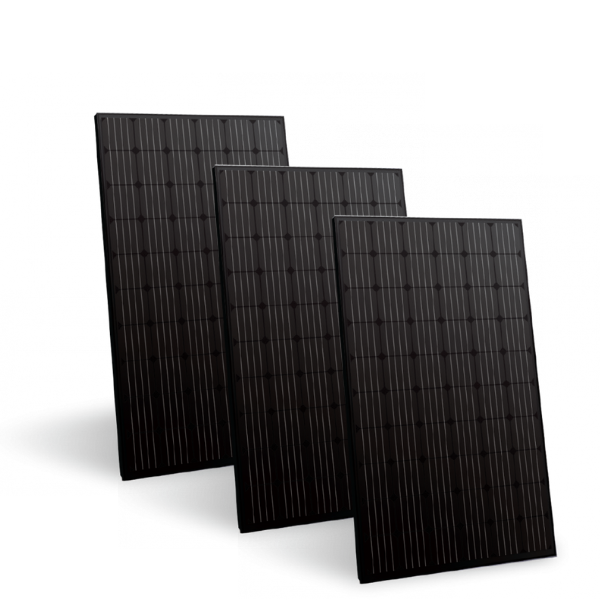
Solar Panels
The biggest and most visible part of any solar system. PV solar panels use sunlight to generate electricity through a process called photovoltaic conversion. Photons are absorbed by the semiconducting material within the solar cells, which creates an electric current. The current is then converted from DC to AC power by an inverter, making it suitable for use in your home or business.
The amount of electricity generated by a solar panel depends on several factors, such as the size and efficiency of the panel, and the amount of sunlight that falls on it. They're most effective in direct sunlight, but modern technology means they’re also still efficient on overcast days.
However, solar panels are a safe and reliable way to generate electricity in Sussex, even during the winter months. As such, a typical family home in Sussex will usually need between 8 and 12 455W panels.
We prefer to use all-black Sunpower Maxeon panels as they offer fantastic performance in all weathers, will last for decades with proper maintenance, and are very well priced.

Solar Panel Optimisers
Optimisers are essential bits of kit installed behind each panel to maximise their performance and electricity generation.
In short, you get the maximum possible power at all times.
They work by continuously monitoring each panel and adjusting the voltage and current output to ensure each one provides maximum output. This helps to mitigate the impact of shading on the performance of solar panels, which can significantly reduce their output.
When one solar panel in a system is shaded, its ability to generate power is reduced, which can affect the output of the entire system. However, solar panel optimisers allow each panel to operate independently, ensuring that the output of the shaded panel does not significantly impact the others.
Alongside this, optimisers have built-in safety features that protect the panels and other components in the system from overvoltage and overcurrent. This helps to prevent damage to the system, ensuring its longevity and reliability to protect your investment.

Solar Inverters
The inverter is a critical component of a solar system that converts the DC (direct current) electricity generated by solar panels into the AC (alternating current), which we use in our homes.
Inverters also have several safety features built in, such as overvoltage and overcurrent protection, to ensure that the system operates safely and reliably at all times.
There are several types of inverters available for solar systems, including string inverters, microinverters, and power optimisers. String inverters are the most common type of inverter and are typically used in larger systems. They are installed in a central location and are connected to multiple solar panels in a series, also known as a string.
Microinverters and power optimisers are newer types of inverters that are installed on each solar panel in a system. They work by optimising the performance of each panel, which can help to increase the overall energy yield of the system and maximise the return on your investment.
.webp)
Solar Batteries for Energy Storage
Solar batteries are an optional, but highly recommended, component of a solar system that can significantly increase the overall efficiency of your installation.
Solar batteries (sometimes called home batteries) work by storing the excess energy generated by the solar panels during the day and releasing it when it is needed, such as at night or during periods of low sunlight. This can help to reduce the amount of electricity that needs to be purchased from the grid.
If needed, solar batteries can also be charged from the grid during off-peak hours for use later. In fact, you don’t even need panels at all to get the benefits of a home battery.
Because all of our systems are bespoke, we work with you to understand your requirements and how much power your system will generate, to recommend the perfect solar battery for you.
Savent Solar are fully certified to install Solar Edge, Enphase, Powervault, Sig Energy, Tesla Powerwall, and other home batteries.

Electric Car Charging (myenergi Zappi)
We can integrate myenergi Zappi EV chargers into any solar system to charge your EV from solar-generated power. Save even more money and maximise your system's effienciency by going completely green.
The Zappi charger is designed to maximise the use of solar-generated electricity by intelligently controlling the flow of energy to the car and adjusting the charge rate based on the amount available.
An EV charger can be incorporated into any bespoke system, or retrofitted to your existing solar installation. The Zappi charger also has several safety features built-in, such as overvoltage and overcurrent protection, to ensure that the charging process is safe and reliable. The charger is compatible with most electric vehicles and can be installed both indoors and outdoors.
In addition to its innovative charging capabilities, the Zappi charger also has a range of features that make it a versatile and convenient charging solution. For example, it can be set to charge at specific times, such as during off-peak hours when electricity prices are lower. It can also be set to charge at a certain rate, such as at a slower rate to reduce the impact on the grid during periods of high demand.

Solar Immersion Heaters
(Solar iBoost)
A Solar iBoost immersion controller can be integrated into any solar system, to maximise the use of excess solar-generated electricity by diverting it to heat water using an immersion heater.
If you don't need or can't fit a solar battery, a solar immersion diverter can be a great way to make the most of the power you generate and reduce your bills.
The Solar iBoost controller is compatible with most immersion heaters and can be easily installed alongside a solar system. It also has several safety features built-in, such as overvoltage and overcurrent protection, to ensure that the immersion heater is operated safely and reliably.
Using the Solar iBoost immersion controller can help to increase the self-consumption of solar-generated electricity and reduce reliance on the grid. It can also help to reduce energy bills by heating water using excess solar energy, reducing the need to purchase electricity from the grid to heat water.
In addition to its energy-saving capabilities, the Solar iBoost immersion controller also has a range of features that make it a convenient and user-friendly device. For example, it can be set to operate at specific times, such as during off-peak hours when electricity prices are lower. It can also be set to operate at specific temperatures, ensuring that the water is heated to the desired temperature.
Solar Mounting Systems
We offer solar for a wide variety of needs, and are able to tailor your solar system to perfectly suit you and maximise your roof space and power generation.
The two most common roof types are flat roof and pitched roof, each of which has its own mounting system for attaching your solar panels. We can install solar on both, even within the same project.
We can arrange how your solar panels are mounted to fit your needs, whether that's to maximise the number you're able to fit on your roof, or to cover a smaller area.
Pitched Roof Mounted Solar

Mounting System
Pitched roof solar installations utilise a mounting system that is attached directly into the frame of your house, this ensures your solar panels are secure and fixed to your roof.
The roof anchors are directly fixed to the frame of the house, and go underneath your roof tiles, this ensures your roof stays completely watertight.
The frame is then bolted to the roof anchors, and forms a flat surface for the panels to be attached to.
The solar panels are then placed on top of the frame, and clamped to it using specially designed fasteners.
The mounting systems we use make maintenance easier, so should your solar system ever encounter an issue, it's easy to fix.
Sun Exposure
Slightly different mounting systems are used depending on the type of tiling present on your roof. Regardless of roof-type each mounting system is incredibly secure so you never have to worry about your panels coming loose.
Where your solar panels are placed depends on the direction your house is facing. We will go over the optimal placement of your solar panels to ensure you have the maximum sun exposure, and guarantee you get the most efficient design of your solar system.
Solar PV generation works on all East West, South roof aspects with a 35-40 degree pitch, all very common in the UK.
Flat Roof Mounted Solar

Mounting System
Flat roof solar installations utilise a mounting system that consists of a frame, ballast, and the panels themselves.
The frame is laid out and connected on the flat roof, ballast is then placed on the frame to anchor it down.
The ballast consists of large stone blocks, the weight of which is more than sufficient to prevent any movement of the mounting system.
The solar panels are then placed on top of the frame, and clamped to it using specially designed fasteners.
Sun Exposure
The flat roof mounting system is available in east/west or south facing configurations. Both of these are designed to allow your solar panels to optimally capture sunlight depending on the location and orientation of your home or business.
The type of configuration that will be best for your flat roof will be advised following the site survey.
On flat roofs, we tend to install systems with a shallower pitch of just 10 degrees to ensure they are more aesthetically pleasing and minimise on wind-shear.
Ground Mounted Solar

Mounting System
Ground mounter solar installations utilise large open areas to generate power from space that otherwise would have been wasted.
Similar to the flat roof mounting system, ground mounted solar installations consist of a frame, ballast, and the panels.
The frame is laid out and connected on the ground, ballast is then placed on the frame to anchor it down, as well as any additional fixings that may be needed.
The solar panels are then placed on top of the frame, and clamped to it using specially designed fasteners.
Sun Exposure
Because there are no restrictions based on roof direction, ground mounted solar panel systems can be perfectly arranged to maximise exposure and efficiency.